
- Empty cart.
- Continue Shopping
Robotics Design, Simulation and Control Pathway Using ROS 2, Gazebo, MATLAB Simulink and SOLIDWORKS
-23%Hot
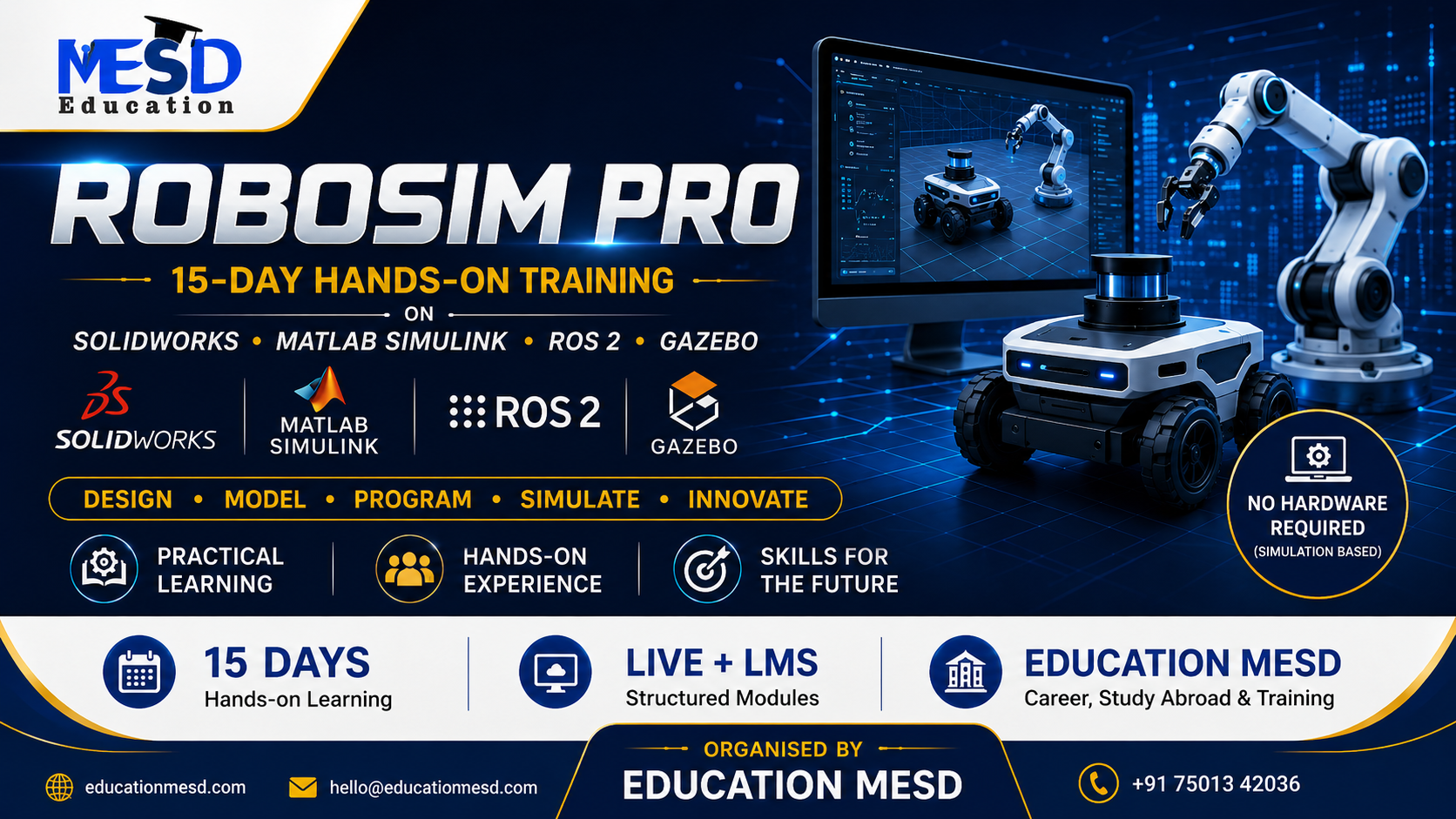
Robotics Design, Simulation and Control Pathway Using ROS 2, Gazebo, MATLAB Simulink and SOLIDWORKS
Original price was: ₹12,999.00.₹9,999.00Current price is: ₹9,999.00.
Add to cart
Buy Now
This training program introduces students to the complete robotics development pathway, starting from 3D mechanical design, moving into robot simulation, then progressing to robot control and automation using ROS 2 and MATLAB Simulink.
The course is designed for students who want to understand how real-world robots are designed, simulated, controlled, tested, and prepared for deployment. Students will work in a software-first environment using industry-relevant tools such as SOLIDWORKS, Gazebo, ROS 2, MATLAB and Simulink.
ROS is an open-source software framework used for building robotic applications, while Gazebo provides a simulation environment where students can test robot models and worlds without physical hardware. Gazebo officially supports interaction with ROS 2, including communication of robot data, commands, joint states, transforms, and visualization workflows.
For 2026, ROS 2 Lyrical Luth is the latest LTS release and is supported until May 2031. For institutions using Ubuntu 24.04, ROS 2 Jazzy Jalisco is also a stable LTS option supported until May 2029.
MATLAB and Simulink will be used for mathematical modelling, control system design, simulation, and ROS integration. MathWorks provides ROS Toolbox and Robotics System Toolbox for connecting to ROS networks, visualizing ROS data, using rosbag files, and developing algorithms for manipulators and mobile robots.
SOLIDWORKS will be used for 3D CAD modelling, mechanical design, assembly design, motion understanding, and early-stage validation of robot structures. SOLIDWORKS also supports product development and simulation workflows for testing designs, optimizing efficiency, and reducing physical prototyping effort.
2. Main Objective
The main objective of this program is to train students in a complete robotics workflow:
Design → Model → Simulate → Control → Integrate → Demonstrate
By the end of the training, students will be able to design basic robot components in SOLIDWORKS, simulate robotic environments in Gazebo, create ROS 2 nodes, publish and subscribe to robot data, and build basic control models using MATLAB Simulink.
3. Learning Outcomes
After completing this program, students will be able to:
- Understand the robotics development pipeline from mechanical design to software control.
- Create basic mechanical parts and assemblies using SOLIDWORKS.
- Understand robot modelling concepts such as links, joints, frames, sensors, and actuators.
- Build and simulate a robot environment in Gazebo.
- Install and use ROS 2 for robotic communication.
- Understand ROS 2 concepts such as nodes, topics, messages, services, launch files, and packages.
- Connect ROS 2 with Gazebo for robot simulation.
- Use MATLAB and Simulink for basic robot control and algorithm testing.
- Develop a simulation-based mini robotics project.
- Prepare a project report and demonstration suitable for academic presentation.
4. Tools Covered
| Tool | Purpose in Training |
|---|---|
| SOLIDWORKS | Robot body design, parts, assemblies, mechanical modelling |
| Gazebo | Robot simulation, virtual worlds, sensors, robot testing |
| ROS 2 | Robot communication, control architecture, nodes, topics, services |
| MATLAB | Mathematical modelling, data analysis, control logic |
| Simulink | Block-based control design and simulation |
| RViz | Robot visualization and sensor data visualization |
| Ubuntu/Linux | Robotics development environment |
| Python/C++ basics | ROS 2 node programming |
Module 1: Robotics Foundation and Development Pathway
Module Focus
This module introduces students to the field of robotics and explains how real-world robotic systems are developed using mechanical design, electronics, software, simulation, and control.
Topics Covered
- Introduction to robotics
- Types of robots: mobile robots, robotic arms, drones, humanoids, industrial robots
- Basic components of a robot
- Sensors, actuators, controllers and power systems
- Robotics development lifecycle
- Hardware-based robotics vs simulation-based robotics
- Role of AI, IoT and automation in modern robotics
- Career opportunities in robotics and automation
Practical Activity
Students will prepare a basic block diagram of a robot system showing the relationship between mechanical body, sensors, actuators, controller, power supply, and software.
Learning Outcome
After completing this module, students will understand the structure of robotic systems and the complete pathway from robot design to simulation and control.
Module 2: SOLIDWORKS for Robotics Design
Module Focus
This module focuses on the mechanical design side of robotics. Students will learn how robot parts and assemblies are created using SOLIDWORKS.
Topics Covered
- Introduction to SOLIDWORKS interface
- Basic sketching tools
- 2D sketch to 3D part modelling
- Extrude, cut, fillet, chamfer and pattern tools
- Robot chassis design
- Wheel and motor placement concept
- Sensor mounting space design
- Battery and controller placement concept
- Assembly design
- Basic mates and constraints
- Design documentation and screenshots
Practical Activity
Students will design a basic mobile robot chassis with wheel placement, motor area, sensor mounting area and controller space.
Learning Outcome
After completing this module, students will be able to design basic robot structures and understand how mechanical design supports robotics development.
Module 3: Linux and ROS 2 Foundation
Module Focus
This module introduces students to the Linux-based robotics development environment and the fundamentals of ROS 2.
Topics Covered
- Linux basics for robotics
- Terminal commands
- ROS 2 introduction
- Importance of ROS 2 in robotics
- ROS 2 workspace
- ROS 2 packages
- Build system
- Source command
- ROS 2 command-line tools
- Introduction to Python-based ROS 2 development
Practical Activity
Students will create a ROS 2 workspace, create a basic package, build the workspace, and run simple ROS 2 commands.
Learning Outcome
After completing this module, students will understand the basic environment required for ROS 2-based robotics development.
Module 4: ROS 2 Communication and Programming
Module Focus
This module focuses on the communication architecture of robots using ROS 2. Students will learn how different parts of a robotic system communicate with each other.
Topics Covered
- ROS 2 nodes
- Topics
- Messages
- Publisher-subscriber model
- Services
- Parameters
- Launch files
- Multi-node execution
- Debugging ROS 2 applications
- Basic robot communication workflow
Practical Activity
Students will create a publisher node and subscriber node. One node will publish robot status or movement commands, and another node will receive and display the message.
Learning Outcome
After completing this module, students will be able to create basic ROS 2 applications using nodes, topics, messages and services.
Module 5: Gazebo Simulation for Robotics
Module Focus
This module introduces students to robot simulation using Gazebo. Students will learn how a robot can be tested in a virtual environment before real-world deployment.
Topics Covered
- Introduction to Gazebo
- Importance of simulation in robotics
- Gazebo world
- Physics-based simulation
- Ground plane and obstacles
- Robot models
- Links and joints
- Visual and collision elements
- Sensor simulation concept
- Robot movement inside a virtual world
Practical Activity
Students will create or modify a basic Gazebo world with ground plane, obstacles and a robot simulation environment.
Learning Outcome
After completing this module, students will understand how to simulate robot movement and test robot behaviour in a virtual environment.
Module 6: ROS 2 and Gazebo Integration
Module Focus
This module connects ROS 2 with Gazebo so students can control simulated robots using ROS 2 commands and communication topics.
Topics Covered
- ROS 2 and Gazebo workflow
- Robot state publisher
- Joint state publisher
- Command velocity topic
- Teleoperation concept
- Sensor data flow
- ROS 2 topics for simulated robot control
- RViz visualization
- Robot movement testing
Practical Activity
Students will control a simulated robot in Gazebo using ROS 2 commands. They will test forward, backward, left, right and stop movement.
Learning Outcome
After completing this module, students will be able to integrate ROS 2 with Gazebo and control a robot in simulation.
Module 7: MATLAB and Simulink for Robotics Control
Module Focus
This module introduces students to model-based robot control using MATLAB and Simulink. Students will learn how control logic is designed and tested before implementation.
Topics Covered
- Introduction to MATLAB for robotics
- Introduction to Simulink
- Block-based modelling
- Input-output system modelling
- Basic control system concept
- PID control concept
- Speed control
- Direction control
- Sensor-based decision logic
- Simulink model for robot control
- Overview of ROS and MATLAB/Simulink workflow
Practical Activity
Students will create a simple Simulink model for robot motion control, such as speed control, direction control, or obstacle response logic.
Learning Outcome
After completing this module, students will understand how MATLAB Simulink is used for designing and testing robot control systems.
Module 8: Integrated Robotics Mini Project
Module Focus
This module allows students to apply the knowledge gained from all previous modules and develop a simulation-based robotics mini project.
Project Areas
Students may choose one project from the following:
- Obstacle avoidance robot simulation
- Warehouse delivery robot simulation
- Hospital service robot simulation
- Smart campus delivery robot
- ROS 2-based teleoperation robot
- PID-based robot motion control using Simulink
- Robot chassis design using SOLIDWORKS
- Autonomous mobile robot simulation using ROS 2 and Gazebo
- Agricultural field robot simulation
- Rescue robot simulation in an obstacle environment
Project Deliverables
Students will submit:
- Project title
- Project objective
- Tool list
- System architecture diagram
- SOLIDWORKS design screenshot
- ROS 2 code/package
- Gazebo simulation screenshot or video
- Simulink model screenshot
- Result explanation
- Final project report
- Presentation/demo
Learning Outcome
After completing this module, students will be able to develop and present a basic robotics project using design, simulation, communication and control tools.
-
General
-

Announcements
-
-
New section
-
New section
-
New section
-
New section
-
New section
-
New section
-
New section